

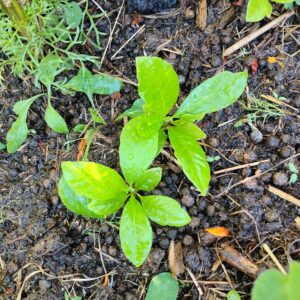
rose of sharon is a hardy, summer-flowering hibiscus, native to the foothills of the himalayas and long cultivated as an ornamental across asia and europe. in mid- to late summer, when many shrubs have finished blooming, it covers itself in showy, funnel-shaped blossoms that last until frost. our seedlings come from a blue-flowering cultivar, so while flower color may vary, many will tend toward striking lavender-blue tones.
ornamentally, rose of sharon is unmatched for late-season color. growing 8–12 feet tall as a multi-stem shrub or small tree, it fits beautifully into hedges, borders, or as a specimen planting. the foliage turns soft yellow in autumn, and the upright seed pods provide winter texture.
in its native range across china, korea, and the himalayan foothills, rose of sharon is a survivor of dry slopes, rocky soils, and woodland edges. it naturally seeds into disturbed ground, forming loose thickets and hedges along paths and village margins. this toughness made it an easy companion for cultivation: in korea it became the national flower, woven into hedgerows and gardens as a symbol of resilience and renewal. even outside its homeland, it thrives in similar conditions, carrying both the wild scrappiness of a pioneer shrub and the elegance of a cultivated ornamental.
as a hibiscus, rose of sharon also carries a quiet herbal lineage. its flowers are edible and can be brewed into teas, much like its close relatives hibiscus sabdariffa (roselle) and hibiscus rosa-sinensis. traditional uses across asia include soothing infusions and cooling tonics, while the mucilaginous leaves and flowers have been applied for their demulcent qualities.
ecologically, it provides nectar for bees, butterflies, and hummingbirds, offering one of the few steady nectar flows in late summer. the shrub is tough, drought-tolerant once established, and thrives in full sun and a wide range of soils.
planting notes
-
height: 8–12 ft
-
spread: 6–10 ft
-
soil: adaptable; prefers well-drained soils
-
light: full sun
-
fall color: soft yellow
-
growth: moderate; hardy and drought-tolerant
-
wildlife: nectar source for pollinators and hummingbirds
-
herbal: flowers edible; used in teas and traditional remedies
Reviews
There are no reviews yet.